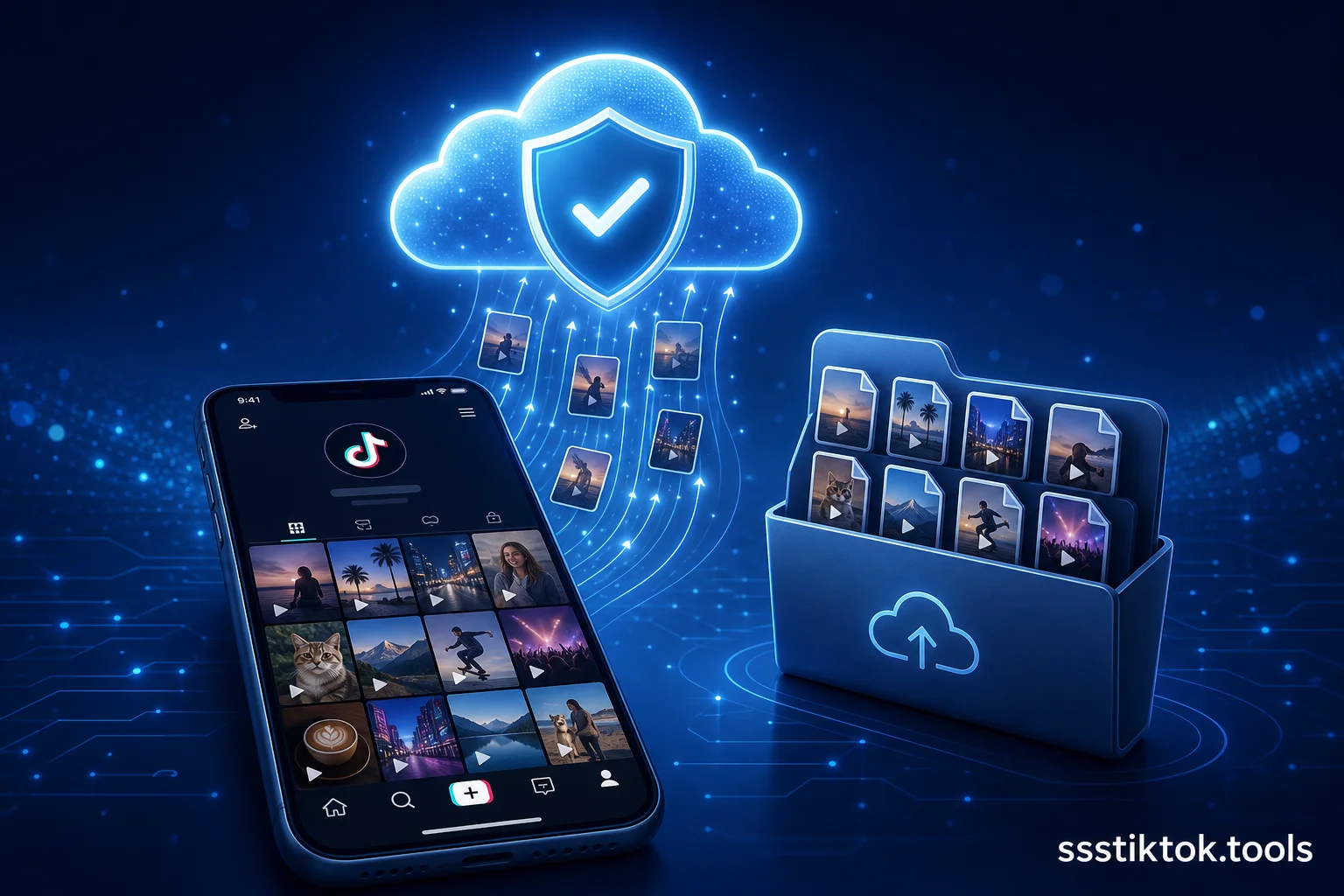
What if you woke up tomorrow and your entire TikTok account was just gone — every video, every comment, every follower you built up? For creators across Indonesia, where TikTok is practically a national pastime and a real source of income for many, that's not just an annoying thought, it's a genuine business risk. Accounts get banned over misunderstood policy strikes, hacked through phishing links, or lost when a phone breaks or gets stolen with no cloud backup in place.
Backing up your TikTok content isn't something only paranoid people do — it's the same basic habit as backing up photos from your phone, just applied to your videos. This guide walks through every practical method: TikTok's own data export tool, mass-downloading your public videos with ssstiktok.tools, saving videos you've liked, and organizing everything so your backup is actually useful when you need it.
Why You Should Back Up Your TikTok Account
A backup feels unnecessary right up until the day you need one, and by then it's already too late to start. Here's why so many Indonesian creators end up wishing they had backed up sooner.
Bans and account loss
TikTok's moderation is largely automated, and automated systems make mistakes at scale. Accounts get suspended over false copyright strikes, misapplied community guideline flags, or enforcement sweeps that catch innocent accounts along with real violators. You can appeal, but that can take weeks with no guaranteed outcome. If years of content only exist inside an app you've suddenly lost access to, an unlucky ban means everything is gone for good. A local backup means the ban only costs you the account, never the actual content.
Platform uncertainty and migration
TikTok has already faced a nationwide ban in Indonesia once before (2018, later lifted) and continues to face regulatory pressure around its e-commerce features and content moderation. No app, however dominant it looks today, is guaranteed to stay exactly as it is forever. Creators who build a following on TikTok alone, without storing their own content anywhere else, are essentially betting everything on decisions made by a company — and regulators — they don't control. Keeping your own archive means you can rebuild your audience elsewhere, repurpose content into a portfolio, or simply keep memories safe no matter what happens to the app.
Method 1: TikTok's Official Data Export
TikTok includes a built-in tool for downloading a full copy of your account data, and it's the most complete option since it covers far more than just your videos.
How to request your data
Open TikTok, go to your profile, tap the three-line menu in the top right, then choose Settings and privacy. From there go to Account → Download your data. Pick a format — JSON is more complete and machine-readable, TXT is easier to skim manually — then confirm the request. TikTok will notify you once it's ready, usually within 24 to 48 hours, though larger accounts can take a bit longer.
What's included in the export
The export covers posted videos, direct messages, comments you've made and received, follower/following lists, search history, and basic profile details. Depending on the format chosen, videos may come as playable files or just as links — picking actual video files means a longer wait and a much bigger download size. One important thing to know: TikTok's export generally doesn't include unpublished drafts, since drafts never leave your device in the first place, so those need a separate backup through your phone's own storage or cloud backup app.
Method 2: Download Your Videos with ssstiktok.tools
If you want quick, individual access to your published videos without waiting a day or two for an export, downloading directly through a tool like ssstiktok.tools works instantly and gives you full-quality, watermark-free files right away.
Finding your own video links
Go to your profile, open each video you want saved, tap the Share icon, then select Copy link. Repeat this for every video you want in your backup. If you post frequently, go through your grid systematically from newest to oldest so nothing gets missed.
Downloading without watermark
Paste each link into the box on ssstiktok.tools and tap download. The tool fetches the original file directly from TikTok's servers, without the spinning TikTok logo watermark that gets stamped on when a video is shared or reposted elsewhere. This matters a lot if you plan to reuse your content on Instagram, YouTube Shorts, or elsewhere later — a clean file always looks more professional than a re-downloaded, watermarked one.
Organizing Your Backup
Downloading is only half the job. A backup you can't actually find or use later isn't really a backup — it's just clutter taking up storage.
Folder structure and naming
Create a dedicated top-level folder, something like "TikTok Backup," then split it by year or by content type, whichever way you naturally think about your videos. Rename files with a consistent pattern — date plus short description, like 2026-07-15_dance-challenge.mp4 — instead of leaving them with random ID numbers. Future you will be grateful when trying to find a specific clip six months from now.
Cloud storage options
Once your videos are saved locally, upload a copy to at least one cloud service — Google Drive, iCloud, Dropbox, or whichever you already use — so you're protected even if your phone gets lost, stolen, or damaged. Following the classic 3-2-1 backup rule works well here: three total copies, on two different storage types, with one copy kept off-site (which cloud storage naturally provides). It sounds excessive for casual content, but it only takes a few minutes to set up and removes any single point of failure.
FAQ
Can I get my TikTok videos back after a ban?
Not directly from TikTok once an account is permanently banned — access to the app and any export tools is cut off right away. This is exactly why backing up before anything happens matters so much: if you've already saved your videos locally or to the cloud, a ban only costs you the account, never the content itself.
Does the data export include drafts?
Usually not. Drafts that were never published typically stay only on the device where they were created, so TikTok's account export doesn't capture them. Back up drafts separately through your phone's own backup system (a full device backup to Google or iCloud, for example) or export them individually before uninstalling the app.
How do I back up liked or saved videos?
Liked and saved (favorited) videos belong to other creators, so TikTok's data export only lists them as references, not full files. To keep an actual copy, open each liked or saved video, copy its share link, and run it through ssstiktok.tools the same way you would your own videos.
How often should I back up my TikTok content?
If you post regularly, a monthly backup routine is a reasonable baseline — often enough to limit potential losses without turning it into a chore. Creators posting daily might prefer a lighter weekly pass covering just the newest uploads since the last backup.
Jangan tunggu sampai kena banned atau error dulu baru sadar pentingnya backup — mulai simpan video TikTok kamu hari ini.
Download Video TikTok Kamu →